Stone vanity tops, basins, shower trays and wall cladding: which material suits where, which finish you need, and how to make a stone bathroom last for years.
The bathroom is where stone shows off its beauty most. It is also where it is tested hardest: water every day, humidity, soap, cosmetics, limescale. In a home or a hotel on Santorini there is one more thing to deal with: vaults, niches and curves, where nothing off the shelf quite fits.
Let's take the four main parts of a stone bathroom one at a time.
The vanity top
The vanity is the surface you touch most, so the material matters.
Natural marble brings warmth and individuality, but it is calcareous and sensitive to acids. Some cosmetics and, above all, limescale removers can dull it. Engineered quartz is non-porous, needs no sealing and keeps a consistent colour. Dekton is highly resistant to stains and chemicals, which is valuable in hotel bathrooms where cleaning is daily and thorough.
Then there is the look. A slim top feels light and contemporary. With mitred edges (joined at 45°), the same top can read as a solid block of stone.
Think about the upstand too, the strip of stone on the wall behind the vanity. It protects the wall from splashes and ties the top into the room. In many bathrooms it keeps going up to the ceiling and becomes the wall cladding itself.
The basin
A basin can sit on top of the vanity, or be carved from the same stone so that top and bowl become one piece. The second option gives a clean, sculptural look and fewer joints for grime to collect in.
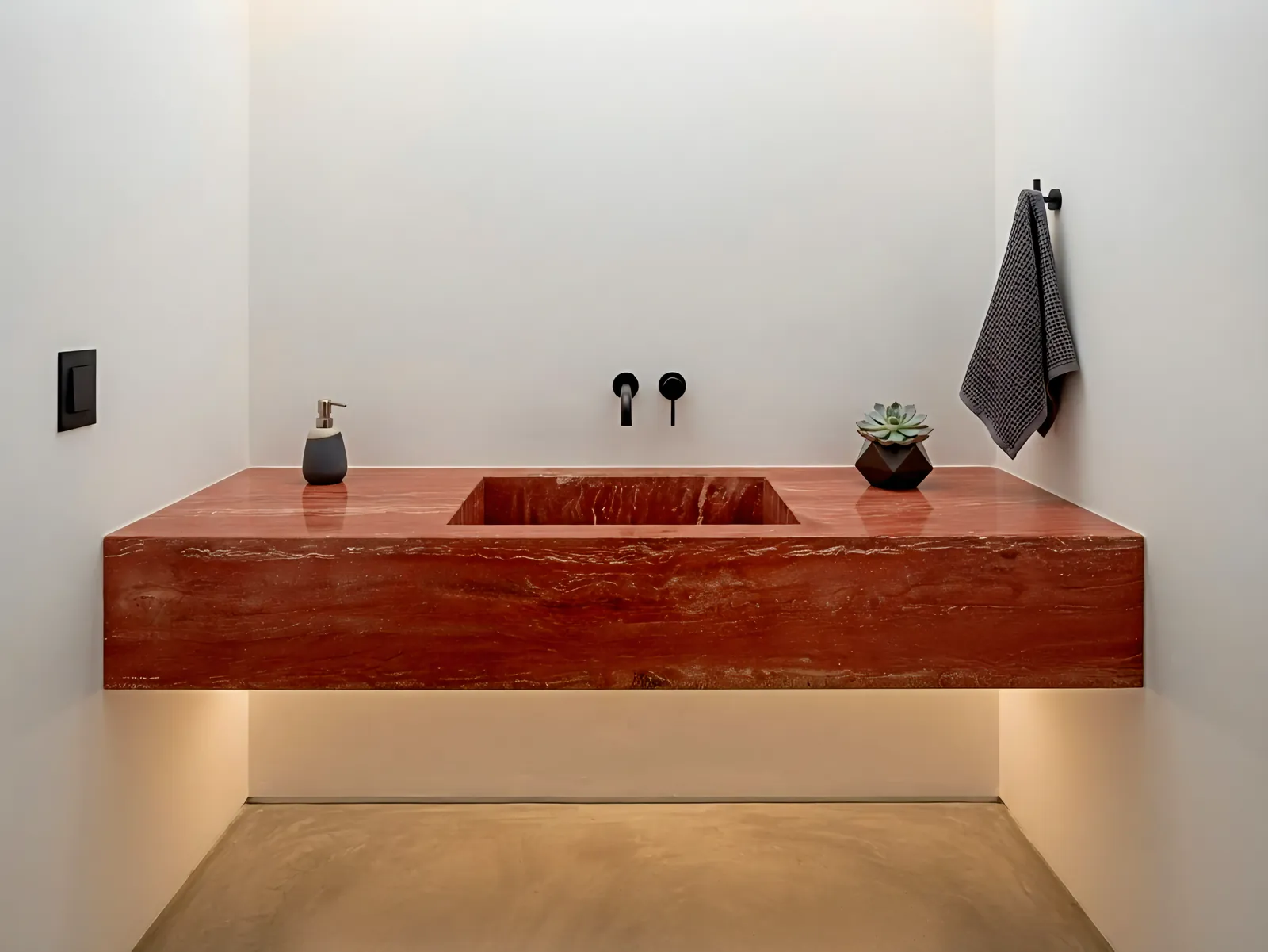
In one of our projects, a floating vanity in red Travertino has its bowl carved into the same stone, with hidden lighting underneath. In another, dark Emberador Dark forms a curved vanity with an integrated basin and shelves set into niches.
Either way, details like a bowl that slopes properly to the waste and rounded inside corners make a real difference when it comes to cleaning.
The shower tray
A stone shower tray, flush with the floor or with a low lip and a linear drain, gives a bathroom calm and clean lines. Two things are non-negotiable here.
The first is the right fall, so water drains away instead of pooling. The second is slip resistance. A polished finish gets slippery when wet, so shower floors call for a textured finish, such as honed, brushed or sandblasted, or for grooves cut into the surface.
Often the same stone carries on up the walls, and a glass screen lets the material be seen in full. In the showers we have made, the stone changes character from project to project: dark with orange veining, green in bands, white with grey movement, or a soft beige.
Wall cladding
On walls, stone in large slabs means fewer joints: a calmer look and easier cleaning. With strongly veined stone, book matching, where two consecutive slabs open out like the pages of a book, turns a plain wall into the centrepiece of the room.
If you choose travertine, decide whether its natural pores will be filled or left open. In areas that get wet often, filled is usually the better choice.
A few practical points for a long life
- Good ventilation, so moisture does not linger.
- A rubber squeegee in the shower after each use, for less limescale.
- pH-neutral cleaners, and never acidic limescale removers on marble or travertine.
- Sealing for natural stone, especially in the areas that get wet.
Made to fit your space
In Cycladic architecture, very little is standard. That is why every vanity, basin and shower tray is cut and finished in our own workshop here on Santorini, to the measurements of the space. And installation is personally supervised.
For hoteliers, where the same bathroom is repeated across many rooms, consistency of material and precision of cut matter even more.
Planning a bathroom for a home or a hotel? Ask us for a quote and let's find the right stone for it together.